The MU-RTS frame is a Trigger Frame in 802.11ax which has a trigger sub-field type value of 3.
The MU-RTS frame purpose is to elicit a CTS response from atleast one of MU capable Stations addressed in the MU-RTS frame. The Trigger Frame format remains the same for MU-RTS. However,
- Most of the common info –> Trigger dependent common info field and
- Most of the elements in the user info –> Trigger dependent user info field are not required for an MU-RTS transmission.
The below diagram shows the parameters that are used and the parameters that are set as reserved in the MU-RTS frame for the above fields.
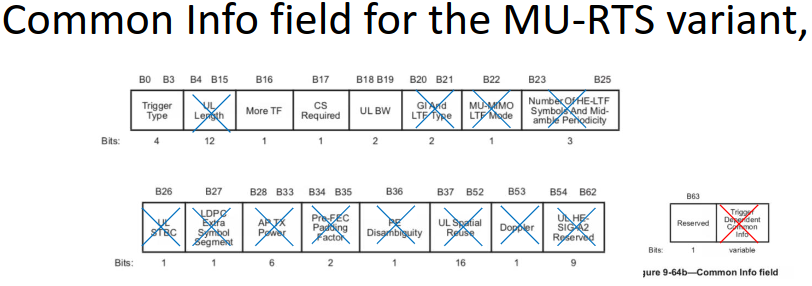
The fields that are used are marked “X” are reserved. The other elements are
- Trigger Type – set to 3 for MU-RTS
- More TF – set to 0 mostly. used for TWT or Power Save with UORA
- CS Required – set to 1 if responding stations need to use ED values to sense and determine if medium is free before responding. Set to 0 otherwise
- UL BW – For a MU-RTS frame, it determines the bandwidth of the frame carrying the MU-RTS
| UL BW value | Description of value |
| 0 | 20 MHz |
| 1 | 40 MHz |
| 2 | 80 MHz |
| 3 | 80+80 or 160 MHz |
The User info field for the MU-RTS variant also does not require many of the fields and is shown below
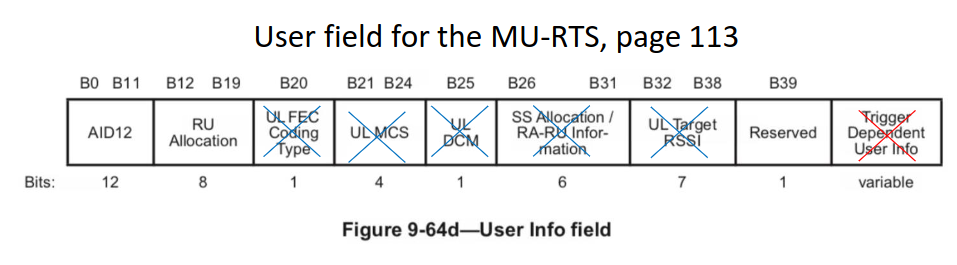
The fields that are used are marked “X” are reserved. The other elements are
- AID12 – indicates the Station ID for each recipient
- RU Allocation – for an MU-RTS, it determines on which primary channel the CTS frame should be sent by the non-AP station
Buffer Status Reports (BSR) – Unsolicited BSR
Pingback: Basic Trigger Frame in 802.11ax | Hitch Hiker's Guide to Learning
for 80MHz case, a standard example is that 4 20MHz CTS are tranmistted back from 4 STAs folloing MU-RTS initiated by AP. But what would happen if AP wants to support more than 4 STAs in DL OFDMA? Will more than one MU-RTS/CTS procedure happen so that more than 4 STAs can be supported before the HE PPDU transmission?
I have not been following comments too much, hence the delay in responding to comments. The AP will be able to process the different CTS from various stations via spatial multiplexing – no? The responses from different stations will differ from each other in phase. The AP can decode the different signals from various stations. It can allocate necessary RU to accommodate as many stations as necessary and be able to service more than 4 stations if need arises. Is that what you were looking at? Else, Is the question different?